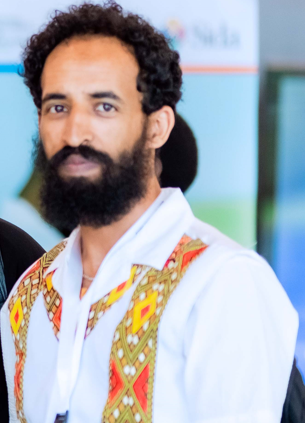
Dr Walelign Tewabe Sewunetie is a Machine Learning and Natural Language Processing (NLP) researcher, Knowledge and Technology Transfer (KTT) Scientist, and Assistant Professor of Computer Science. He is currently based at the African Institute for Mathematical Sciences – Research and Innovation Centre (AIMS-RIC) in Rwanda, where he drives initiatives that connect cutting-edge AI research with practical applications in education, healthcare, governance, and entrepreneurial innovation.
He earned his PhD in Information Science and Technology from the University of Miskolc (Hungary). He also holds an MSc in Computer Science from Arba Minch University and a BSc in Computer Science from Mekelle University, Ethiopia. Dr Sewunetie has previously served in senior leadership roles at Debre Markos University’s Institute of Technology (Ethiopia) as Managing Director and Deputy Registrar, contributing to institutional strengthening and digital transformation. He continues to mentor MSc and PhD students across multiple universities in Africa and Europe, with a strong focus on AI for social good.
His contributions span AI-driven healthcare systems, multilingual machine translation for low-resource African languages, bias mitigation in AI models, and intelligent tutoring systems. He has also led several international collaborative projects funded by the IDRC and AI4D Africa, and co-delivered Design Thinking for TVET teachers training under the Transforming TVET in Rwanda to Become 21st Century TVET program, co-funded by the EU building strong bridges between African research institutions and European innovation ecosystems. Beyond research, Dr Sewunetie is the founder of impactful initiatives such as Girls Can Code, which empowers women in STEM, and for supports academic and professional advancement for women researchers. He has published extensively in peer-reviewed journals and international conferences, and his work has been recognized with multiple awards, including the Best Paper Award at IEEE ICHI 2024 (Florida, USA) and the Best Paper Award at Deep Learning Indaba 2025 (Kigali, Rwanda). He regularly serves as a reviewer and program committee member for international conferences and actively engages in policy dialogues on AI ethics, governance, and inclusivity in Africa.